Does Your Child Dread the Dentist? A Guide to Calmer, Healthier Visits
June 23, 2026
Why Does Cold Make Your Teeth Hurt?
August 18, 2026
How Dental Crowns and Bridges Can Restore Your Smile
By Dr. Joshua Parry, DMD
Maybe it started small. A back tooth felt a little rough and your tongue kept finding the edge. You told yourself you would mention it at your next cleaning. Months later, a bite of something crunchy sends a sharp twinge through that same tooth. Now it’s hard to ignore.
Maybe you have an old filling that has been quietly breaking down for years. Lately it aches when you drink something cold. You are starting to wonder how much longer it will hold.
Or perhaps you lost a tooth some time ago, and you have been chewing around the gap ever since. It has not stopped you from getting through the day, but you notice it in photos, and you wonder what it is doing to the teeth on either side.
If any of this sounds familiar, you are in the right place. A cracked, worn, or missing tooth is one of the most common reasons adults come to see us, and it is very fixable. Two of the most reliable tools we have for the job are dental crowns and dental bridges. Let’s take a look.
What Is a Dental Crown, and When Do You Need One?
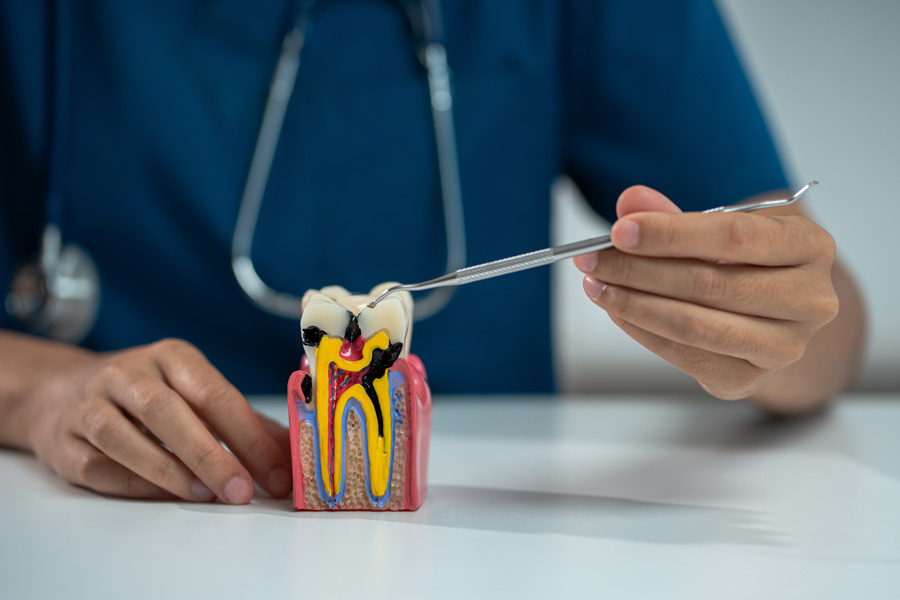
A dental crown is a custom-made cap, shaped and colored to look like a natural tooth, that fits over the entire visible part of a tooth above the gumline. Once it is bonded in place, it becomes the new outer surface of that tooth, restoring its shape, strength, and appearance.
Dentists recommend a crown when a tooth needs more support than a simple filling can provide. According to the American Dental Association, a crown may be recommended to:
- Protect a weak or cracked tooth from breaking further
- Restore a tooth that is already broken or badly worn down
- Support a tooth with a large filling, when little natural tooth structure remains
- Restore a tooth after a root canal, which can leave it more brittle
- Cover a dental implant, or hold a dental bridge in place
The common thread is that the tooth is still there but needs reinforcing. A crown wraps the whole tooth like a helmet, letting you bite and chew normally again while lowering the chance of a painful fracture down the road.
What Is a Dental Bridge, and How Does It Work?
Where a crown restores a tooth you still have, a dental bridge replaces one you have lost. As the name suggests, it bridges the gap left by one or more missing teeth in a row.
A traditional bridge is made of one or more artificial teeth, called pontics, held in place by crowns on the healthy teeth on either side of the gap. Those neighboring teeth, known as abutment teeth, act as anchors. When there are no suitable teeth to anchor to, dental implants can serve as the supports instead.
A well-made bridge does more than fill a space in your smile. It restores your ability to chew and speak clearly, spreads your bite forces more evenly, and helps keep the remaining teeth from drifting out of position into the gap.
What Happens If You Ignore a Cracked, Worn, or Missing Tooth?
It is tempting to wait. The tooth does not always hurt, there’s your budget to consider, and life is busy. But dental problems rarely improve on their own, and they tend to get more complicated (and more expensive) the longer they wait. Here is how these situations usually unfold over time:
- A small crack widens. Each bite flexes the crack a little more, until it reaches the sensitive inner layers of the tooth and turns a simple repair into a root canal or an extraction.
- Decay creeps in around a failing filling. Gaps at the edge of an old filling trap bacteria, and new decay can spread underneath, where you cannot see or clean it.
- Neighboring teeth drift. When a tooth is missing, the teeth beside and above the gap slowly tip and shift, which can change your bite and make future treatment harder.
- Chewing wears unevenly. Favoring one side to protect a sore or missing tooth puts extra strain on the other side and on your jaw.
None of this is meant to alarm you. The point is simply that a tooth is easiest to save when you act early. Addressing a crack, a worn filling, or a gap sooner usually means a smaller, simpler fix.
Marissa Williams, a patient at our practice, shared: “The office and staff are amazing. I have terrible dental anxiety and they made sure to give me time to breathe when I needed it and talked me through everything. They made me very comfortable and took care of my broken tooth quickly.”
Crown, Bridge, Filling, or Implant: Which Is Right for You?
With several options available, it helps to understand when each one is the right tool:
- A filling is usually enough when decay or damage is small and plenty of healthy tooth remains.
- A crown becomes the better choice when a tooth is cracked, heavily worn, or so much of it is missing that a filling would not hold.
- A bridge is a fixed, non-surgical way to replace one or a few missing teeth in a row, using the neighboring teeth for support.
- A dental implant replaces a missing tooth at the root, with a small post placed in the jaw, without relying on the neighboring teeth. It is often the longest-lasting choice for a single missing tooth, though it involves minor surgery and a longer timeline.
There is no one-size-fits-all answer. The best choice depends on how much healthy tooth is left, the condition of the teeth around a gap, your overall oral health, your timeline, and your budget. This is exactly the kind of decision that benefits from an honest, unhurried conversation with a dentist who lays out the trade-offs.
Andrea Beneke, a patient at our practice, shared: “Had first consultation with Dr Parry and staff. Amber checked me in and did x-rays. So gentle and personable – it made me less nervous. Dr. Parry took time to really weigh my options, talk to me, and make suggestions. I am truly grateful for the experience and see how he makes me smile with confidence again.”
What Happens During the Crown or Bridge Process?
Knowing what to expect makes the whole thing less scary. For a traditional crown or bridge, the process usually takes at least two visits.
At the first visit:
- We numb the area with a local anesthetic so you stay comfortable throughout.
- We gently shape the tooth (or the two anchor teeth, for a bridge) to make room for the restoration.
- We capture the shape of your teeth. At Modern Dental Associates, we use an iTero Element digital scanner, which replaces the old, uncomfortable impression trays with a quick, comfortable digital scan.
- We place a temporary crown or bridge to protect the area while your custom restoration is made.
At the second visit, we remove the temporary, check that your permanent crown or bridge fits well and matches your other teeth, and bond it securely in place. We then fine-tune your bite so everything feels natural.
Many patients are surprised by how routine and comfortable the appointment is. Because the tooth is numb, the process itself is essentially painless; the most you are likely to feel is some pressure, and perhaps a little mild soreness afterward that fades within a day or two.
Jenifer Seich, a patient at our practice, shared: “Dr Parry is great! Super friendly and great at his job! Made the filling and crown process very easy and not painful. Shannon is a wonderful hygienist.”
For patients who feel anxious about dental work of any kind, we also offer options to help you relax. Our sedation dentistry page explains more.
How Long Do Crowns and Bridges Last?
With good care, both crowns and bridges are built to last for many years.
- Dental crowns last about 5 to 15 years on average, and it is not unusual for a well-cared-for crown to last considerably longer, according to the Cleveland Clinic.
- Dental bridges commonly last 10 years or more with good oral hygiene, though the American Dental Association notes that a bridge may need replacing after 5 to 7 years in some cases.
The single biggest factor is how you care for the restoration once it is in place. A few simple habits go a long way:
- Brush twice a day and floss daily, just as you would with natural teeth.
- Clean under a bridge. Because the pontic sits above the gum, food can collect beneath it; a floss threader, an interdental brush, or a water flosser makes cleaning that space easy.
- Protect your restoration. Avoid using your teeth as tools, and go easy on ice and very hard candy, which can crack even a strong crown. If you grind your teeth at night, ask us about a night guard.
- Keep up your checkups. Regular visits let us catch a small problem, like a chip or a worn edge, before it becomes a bigger one.
Why Choose Modern Dental Associates?
Restorative work is not just about the tooth in front of us; it is about trusting the hands doing the work. Here is why families across Western Pennsylvania choose Modern Dental Associates for their crowns and bridges.
Crowns and Bridges, Handled In-House
Porcelain crowns and fixed bridges are a core part of what we do. As a comprehensive family dentistry practice with offices in Greensburg, Scottdale, and Homer City, we handle your restoration from the first consultation through the final fitting, all with a team that already knows your history.
Modern Tools for a Comfortable Fit
Our iTero Element digital scanner lets us capture precise, comfortable digital impressions, which means a better-fitting crown or bridge and no mouthful of impression putty.
Honest Options, Clearly Explained
We believe you should understand every choice in front of you. We take the time to walk through the trade-offs of a filling, crown, bridge, or implant, and we help you weigh what fits your mouth, your goals, and your budget.
Rebecca Bamford, a patient at our practice, shared: “I truly hate to go to the dentist. So much so I avoided it for years but when I finally decided I needed to go I'm glad I went here. The staff and Dr. Parry are great. Explains everything very well and all your options are laid out. Also, I appreciate how they check with you frequently during the procedures to make sure your doing ok. Very professional!”
Care That Goes the Extra Mile
Tony Aquilina, a patient at our practice, shared: “Wow!! Amazing staff all around. Great office staff, hygienist, and dentist. I've had a lot of work done the last few months and they are very accommodating and actually care. Dr Parry went to the lab to pick up my crowns the morning of my appointment due to a power outage at the lab. He made sure the appointment stayed on schedule by going way above and beyond for me. HIGHLY RECOMMEND!!”
Ready to Repair or Replace That Tooth?
A cracked, worn, or missing tooth does not have to stay on your mind. With a crown or a bridge, we can restore your bite, your smile, and your comfort, often in just a couple of visits.
Dr. Joshua Parry, DMD, and the Modern Dental Associates team would be glad to look at your tooth, explain your options in plain language, and help you choose the path that is right for you.
To Schedule Your Consultation
Ready to set an appointment, visit our Request an Appointment page.
Or please call:
- Greensburg Office: 724-836-3368
- Scottdale Office: 724-887-7860
- Homer City Office: 724-349-3368
The sooner we take a look, the simpler the fix is likely to be.