Is It a Dental Emergency?
April 23, 2026
Does Your Child Dread the Dentist? A Guide to Calmer, Healthier Visits
June 23, 2026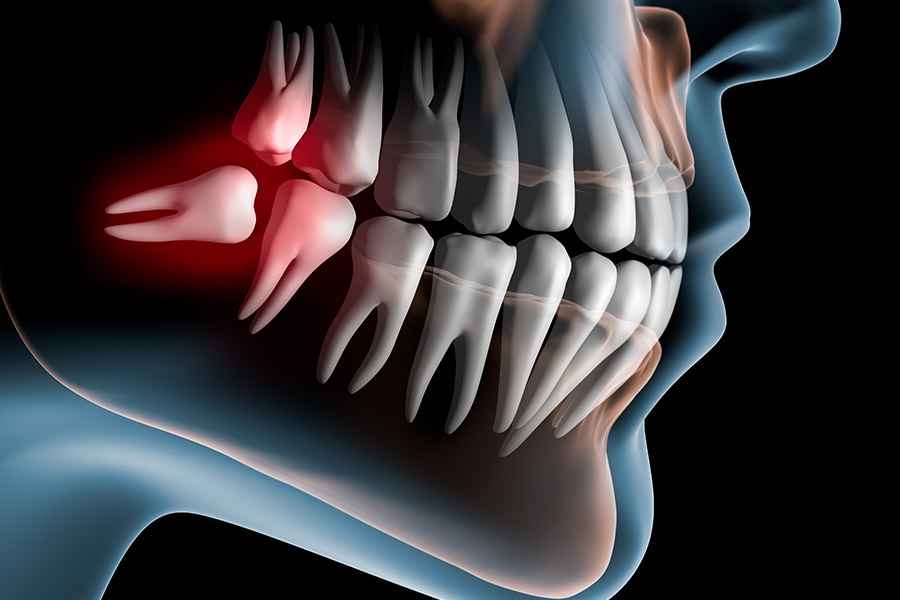
A Straightforward Guide for Teens, College Students, and Adults
By Dr. Joshua Parry, DMD
It started with a strange pressure at the back of your jaw. You ran your tongue over the spot and felt something sharp coming in. Maybe it ached a little when you chewed gum. A few weeks later, brushing back there hurts, and there is a taste in your mouth that won’t quite go away.
That is how wisdom teeth usually announce themselves. Sometimes they cause no trouble at all. Other times they create problems that get worse over months, not minutes.
If you are a parent trying to decide whether your teenager needs a procedure this summer, a young adult facing the choice yourself, or an older adult who has been ignoring a back molar for years, this article is for you. We will walk through what wisdom teeth are, when they need to come out, what the procedure actually involves, and how Modern Dental Associates can help.
What Are Wisdom Teeth, and Why Do They Cause Problems?
Wisdom teeth are the third set of molars at the very back of your mouth. According to the Cleveland Clinic, they typically come in between the ages of 17 and 25. Some people get all four. Some get one or two. Some never develop wisdom teeth at all, and that is perfectly normal.
The problem is that human jaws have gotten smaller over time, while the wisdom teeth themselves have not. For many people, there is simply not enough room left at the back of the mouth for a third molar to come in cleanly.
When that happens, a few things can occur:
- Fully impacted: The tooth never breaks through the gum and stays trapped under the surface.
- Partially erupted: The tooth pushes through only partway. The opening lets bacteria in but is very hard to clean.
- Erupted but tilted or crowded: The tooth comes in at an angle or pushes against the tooth in front of it.
Not every wisdom tooth needs to come out. Wisdom teeth that come in cleanly, line up properly, and can be brushed and flossed like any other tooth may be fine to keep. The decision really comes down to whether the tooth is causing problems, or is likely to.
How Do You Know If Your Wisdom Teeth Need to Come Out?
These are the most common warning signs that a wisdom tooth is starting to cause trouble:
- Pain or pressure at the back of the jaw, especially when chewing
- Swelling or tenderness in the gums around the back molars
- A bad taste or breath that does not improve with regular brushing
- A small flap of gum tissue over a partially erupted tooth that gets sore or red
- Difficulty opening the jaw all the way
- Recurring infections in the same area at the back of the mouth
- Pain or sensitivity in the second molar (the tooth directly in front of the wisdom tooth)
Not every symptom on its own is an emergency. But if any of these last more than a few days, or keep coming back, it is time to schedule an exam. A dental X-ray will show exactly where the wisdom tooth is, how it is angled, and whether it is causing damage that is not yet visible.
What Age Is Best for Wisdom Teeth Removal?
Most dentists and oral surgeons recommend evaluating wisdom teeth in the late teens or early twenties. The reason is straightforward: at that age, the roots of the wisdom teeth are not yet fully formed, and the surrounding bone is less dense. That often makes the procedure and the recovery more manageable.
That is why summer break is such a common time for parents to schedule the procedure for a teenager or college student. The window between high school and freshman move-in, or between spring and fall semesters, lines up well with a one to two week recovery.
That said, wisdom teeth can be removed at any age. Adults in their 30s, 40s, and beyond have wisdom teeth taken out regularly, especially when a problem finally makes itself known. The procedure is still very doable. Recovery may take a bit longer because adult bone is denser and roots are fully formed, but it is still very manageable with the right care.
If you are an adult who has been told for years that a wisdom tooth “should probably come out eventually,” and it is now actively bothering you, that is worth a conversation with your dentist.
What Happens If You Don’t Remove Problem Wisdom Teeth?
When a wisdom tooth is causing problems and you leave it alone, things rarely improve on their own. They tend to get worse, gradually, until something forces the issue.
Here are the most common consequences of leaving a problem wisdom tooth in place:
- Recurring gum infections: A partially erupted wisdom tooth has a flap of gum tissue that traps food and bacteria. This often leads to pericoronitis, a painful infection that swells the area and can come back over and over.
- Decay in two teeth at once: The wisdom tooth itself is hard to reach with a toothbrush, so it often develops cavities. The back side of the second molar (the tooth directly in front) is just as hard to clean and can decay in the same way.
- Gum disease in the back of the mouth: The area around an impacted or partially erupted tooth is very difficult to keep clean, which can lead to bone loss around otherwise healthy teeth.
- Damage to the next tooth: A wisdom tooth growing in at an angle can press against the root of the second molar, sometimes damaging it badly enough to require its own treatment later.
- Cysts in rare cases: In a small number of cases, a fluid-filled sac can form around an impacted wisdom tooth. Cysts are uncommon, but when they appear they can damage surrounding bone and need to be treated.
The reason dentists recommend acting on problem wisdom teeth early is that the smaller the issue, the simpler the fix. An infection that has flared up once is far easier to handle than a decade of recurring infections, decay, and damage to neighboring teeth.
What Happens During a Wisdom Teeth Extraction?
Most patients picture something far more dramatic than the actual procedure. Here is what really happens.
- Consultation and imaging. Before anything else, you come in for an exam. Digital X-rays (and 3D imaging when needed) show exactly where each wisdom tooth is, how the roots are shaped, and how close the tooth is to nearby nerves.
- Discussion of comfort options. Most extractions can be done with local anesthesia, which simply numbs the area around the tooth. For patients with anxiety, or for more complex cases, sedation options can be discussed to help you stay calm and relaxed.
- The extraction. A tooth that has fully erupted is removed from its socket. A tooth that is impacted may require a small incision in the gum, and sometimes the removal of a small amount of bone, to access the tooth. The procedure typically takes about an hour.
- Stitches if needed. If an incision was made, the dentist or oral surgeon places small stitches that usually dissolve on their own within 7 to 10 days.
- Recovery time in the chair. You will rest in the office until you feel steady. If you have had sedation, a friend or family member will need to drive you home.
Most of the procedure feels less like the horror story patients expect and more like a focused, careful visit. The combination of modern imaging, good anesthesia, and a steady team makes the experience very straightforward for the vast majority of patients.
How Long Is Recovery, and What Can You Eat?
According to the Cleveland Clinic, full recovery from a wisdom teeth extraction takes about two weeks. Most people return to school, work, or routine activities within 3 to 5 days. The deeper tissues continue healing for a few weeks beyond that, but you will feel close to normal much sooner.
Here is what to expect, day by day:
- Day 1: Rest at home. Expect mild bleeding, swelling, and some soreness. Bite on the gauze your dentist provides, keep your head elevated, and use a cold compress in 20-minute intervals to reduce swelling.
- Days 2 to 3: Swelling often peaks on day 2 or 3. Stick to soft foods, keep up gentle salt-water rinses (starting 24 hours after surgery), and continue ice as needed.
- Days 4 to 7: Most patients return to school or work. Activity gradually returns to normal. Avoid heavy exercise, smoking, and drinking through a straw.
- Week 2: Most discomfort is gone. The surgical sites continue to heal, but you can resume regular activities.
Good foods for the first few days:
- Smoothies (but not through a straw)
- Yogurt and pudding
- Mashed potatoes
- Scrambled eggs
- Applesauce
- Warm (not hot) soup
- Soft pasta
Avoid for the first week:
- Crunchy foods (chips, popcorn, nuts)
- Sticky or chewy foods (caramels, gum)
- Spicy foods that can irritate the wound
- Very hot drinks
- Anything that requires a straw
The single most important thing you can do during recovery is protect the blood clot in each socket. Drinking through a straw, smoking, or vigorously rinsing in the first few days can dislodge the clot and lead to a painful condition called dry socket.
How Does Modern Dental Associates Help With Wisdom Teeth?
When wisdom teeth become a question, Modern Dental Associates is the right first stop. We provide oral surgery services at our Western Pennsylvania offices in Greensburg, Scottdale, and Homer City, and we handle the evaluation, imaging, and treatment planning that every wisdom teeth case starts with.
From there, the next step depends on what your imaging shows. For some patients with straightforward cases, the extraction can be performed in-house. For most patients, especially those with impacted teeth, complex root positions, or close proximity to nerves, we coordinate care with a trusted oral surgeon. Either way, you have one dental team guiding the process from your first appointment through recovery.
Here is what families and adult patients can expect when they bring a wisdom teeth question to MDA.
Advanced Diagnostics
Dr. Joshua Parry, DMD, and the MDA team use digital X-rays and 3D imaging to evaluate wisdom teeth before any decision is made. That means a clear picture of root development, nerve proximity, and the position of each tooth, before anyone reaches for an instrument.
Honest Recommendations About Where Treatment Happens
Some wisdom teeth come out smoothly in a general dental office. Others involve impactions, unusual root angles, or proximity to nerves that make oral surgery the safer choice. We look at your imaging, talk through what we see, and recommend the path that gives you the best outcome. For most patients, that means a referral to an oral surgeon we trust. For some, the procedure can stay with us. Either way, you get a straight answer based on what your case actually calls for.
Clear Explanations Before Anything Begins
We walk you through the imaging, explain the recommendation, and answer questions about timing, cost, and what to expect from your next step. Parents will know exactly what their teenager is in for. Adult patients will know exactly what to expect before any decision is finalized.
Follow-Up Care Through Recovery
Recovery is part of the procedure, not an afterthought. Whether your extraction is performed at MDA or by a referred oral surgeon, our team remains your dental home. We are here for post-operative questions, follow-up exams, and the long-term care of your teeth and gums.
What Patients Say
If you check us out online, you will find we have hundreds of outstanding Google Reviews. Here is a sample from patients who have trusted us with their dental care, including extractions, anxious first visits, and complex treatment planning.
Shawn Anthony, who needed an extraction for a broken tooth, shared: “Dr. Wagler did an amazing job. She made sure I was comfortable and made the extraction quick, easy and painless. I would recommend anyone to go here for a very pleasant experience.”
Marissa Williams, who has serious dental anxiety, said: “The office and staff are amazing. I have terrible dental anxiety and they made sure to give me time to breathe when I needed it and talked me through everything. They made me very comfortable and took care of my broken tooth quickly.”
Rebecca Bamford, who had avoided the dentist for years before finally coming in, shared: “I truly hate to go to the dentist. So much so I avoided it for years but when I finally decided I needed to go I’m glad I went here. The staff and Dr. Parry are great. Explains everything very well and all your options are laid out. Also, I appreciate how they check with you frequently during the procedures to make sure you’re doing ok.”
Mike Sullivan, who had not seen a dentist in several years before his first visit, shared: “I hadn’t been to the dentist in several years so needless to say I was definitely nervous. Well, that nervous feeling didn’t last long thanks to the friendly and welcoming staff. Everyone I interacted with was pleasant and helpful. The plan moving forward with my teeth was explained to me in an easy to understand way.”
Tony Aquilina, a long-time patient, shared: “Amazing staff all around. Great office staff, hygienist, and dentist. I’ve had a lot of work done the last few months and they are very accommodating and actually care. Dr. Parry went to the lab to pick up my crowns the morning of my appointment due to a power outage at the lab. He made sure the appointment stayed on schedule by going way above and beyond for me. HIGHLY RECOMMEND!”
Frequently Asked Questions About Wisdom Teeth
At what age should wisdom teeth be removed?
Most dentists recommend evaluating wisdom teeth in the late teens or early twenties. The roots and surrounding bone are still developing at that age, which often makes the procedure and recovery more straightforward. That said, wisdom teeth can be removed at any age, and adults have them extracted regularly.
Do all wisdom teeth need to come out?
No. Wisdom teeth that come in straight, line up correctly, and can be cleaned like any other tooth may be fine to leave alone. Removal is generally recommended when a wisdom tooth is causing pain, infection, damage to nearby teeth, or chronic cleaning problems.
How painful is wisdom teeth removal?
Most patients describe the procedure itself as much easier than they expected, thanks to local anesthesia and (when needed) sedation. Discomfort tends to peak in the first 2 or 3 days afterward and is usually well controlled with prescription or over-the-counter pain medication.
How long before I can go back to school or work?
Most patients return to school, work, or routine activities within 3 to 5 days. Full healing of the surgical sites takes about two weeks, with deeper tissues continuing to heal for a few weeks beyond that.
Does insurance cover wisdom teeth removal?
Many dental insurance plans include coverage for wisdom teeth extractions, especially when the procedure is recommended for medical reasons such as infection, damage to nearby teeth, or impaction. Coverage levels and specifics vary by plan. Our team will review your benefits and explain the cost before treatment begins.
What is dry socket and how do I avoid it?
Dry socket is a painful condition that happens when the blood clot in the extraction site is dislodged or dissolves before the wound has fully healed. To reduce the risk: avoid drinking through a straw, do not smoke, do not vigorously rinse your mouth in the first 24 hours, and follow your post-operative instructions carefully.
Will Modern Dental Associates remove my wisdom teeth in-office, or will I be referred?
It depends on the case. For some straightforward extractions, the procedure can be performed in-house at our Greensburg, Scottdale, or Homer City offices. For most cases, especially impacted teeth or complex root positions, we refer to a trusted oral surgeon. The evaluation, the imaging, the recommendation, and the coordination of follow-up care all happen at MDA, so you have one dental team guiding the process from start to finish.
When You’re Ready to Have That Conversation, We’re Here
Wisdom teeth do not always need to come out. But when they do, the decision should be made with good information, clear imaging, and a team you trust to walk you through the whole process.
Dr. Joshua Parry, DMD, and the entire MDA team bring advanced diagnostics, calm explanations, and coordinated care to every wisdom teeth question that comes through our doors. We serve patients throughout Western Pennsylvania from our offices in Greensburg, Scottdale, and Homer City.
Whether you are a parent trying to make a summer decision for your teenager, a young adult facing the choice yourself, or an older adult dealing with a back molar that has finally started causing trouble, we can help you sort it out.
To schedule an evaluation, please call:
- Greensburg Office: 724-836-3368
- Scottdale Office: 724-887-7860
- Homer City Office: 724-349-3368
If you have been putting off a wisdom tooth evaluation, summer is a smart time to take care of it. Call us, and we will help you figure out the right next step.
When You Need Help, We're Here
A dental emergency is stressful. Pain is disorienting, and uncertainty about what to do next makes it worse. At Modern Dental Associates, we have built our practice to be the answer when patients need help most.
Dr. Joshua Parry, DMD, and the entire MDA team bring advanced technology, genuine compassion, and a commitment to same-day access together under one roof. We serve patients throughout Western Pennsylvania from our offices in Greensburg, Scottdale, and Homer City.
You don't have to tough it out alone. You don't have to wait and see. And you don't have to spend hours in an ER waiting room for temporary relief.
If you need emergency, same-day care, please call:
- Greensburg Office at 724-836-3368
- Scottdale Office at 724-887-7860
- Homer City Office at: 724-349-3368
At Modern Dental, we make every effort to see emergency appointments the same day or the next business day, though appointments are scheduled on a first-come, first-served basis.
Don't wait for the pain to get worse. We're ready to help right now.